

The global D2C opportunity has demonstrated unprecedented growth, with 64% of consumers regularly buying from brands directly. From brands like Casper, Dollar Shave Club, and Warby Parker, which made a direct entry on the D2C scene, to global brands like Nike, which recorded 36.8% of revenue from D2C sales - one thing is quite evident, D2C is a customer favorite.
However, what comes as a challenge is not the ability to respond to customer demands but the mammoth size fulfillment costs stemming from complex logistics. With customer demand booming at a rapid rate, partnering with one or two 3PL providers is no longer enough, and there is an aggressive adoption of multiple 3PL providers. This, in turn, becomes a bottleneck in relation to - operational efficiency, visibility, integration, and disparity.
While the business use cases and 3PL requirements vary across the brands, having a reliable, versatile, and robust 3PL aggregation platform can not only help solve these pain points but also plan and strategize toward sustainable business growth.
Multiple Courier Partners in D2C - Challenges
A D2C brand dealing with multiple courier partners may face challenges like-
Inefficient Order Allocation System
It is quite challenging and time-consuming for a D2C brand to manually consider multiple constraints and decide which courier partner would be suitable for a particular type of delivery.
Inability To Track Multiple Shipments In Real-Time
Not being able to track shipments can lead to delivery delays and increased distance traveled, inaccurate ETAs, which impacts both the profitability and customer experience.
Inefficient Reverse Logistics Management
Manually allocating return requests can cause prolonged delays in picking up ‘returns’ orders, which directly impacts customer experience.
Inability To Monitor The Performance Of Each 3PL
Monitoring 3PLs’ performance and measuring their KPIs using traditional practices can cause conflicts between the D2C brand and 3PLs.
3PL Aggregation in D2C - Value Proposition
A 3PL aggregation platform enables D2C brands to manage and monitor multiple third-party logistics partners on a single dashboard. Here are some more benefits it renders:
Reduced Operational Costs
3PL aggregation platforms can significantly reduce operational costs by automating operations such as billing, invoicing, and label generation in a format accepted by all carriers. Moreover, it also allows D2C businesses to save the cost of hiring human resources, distribution, fleet, and delivery.

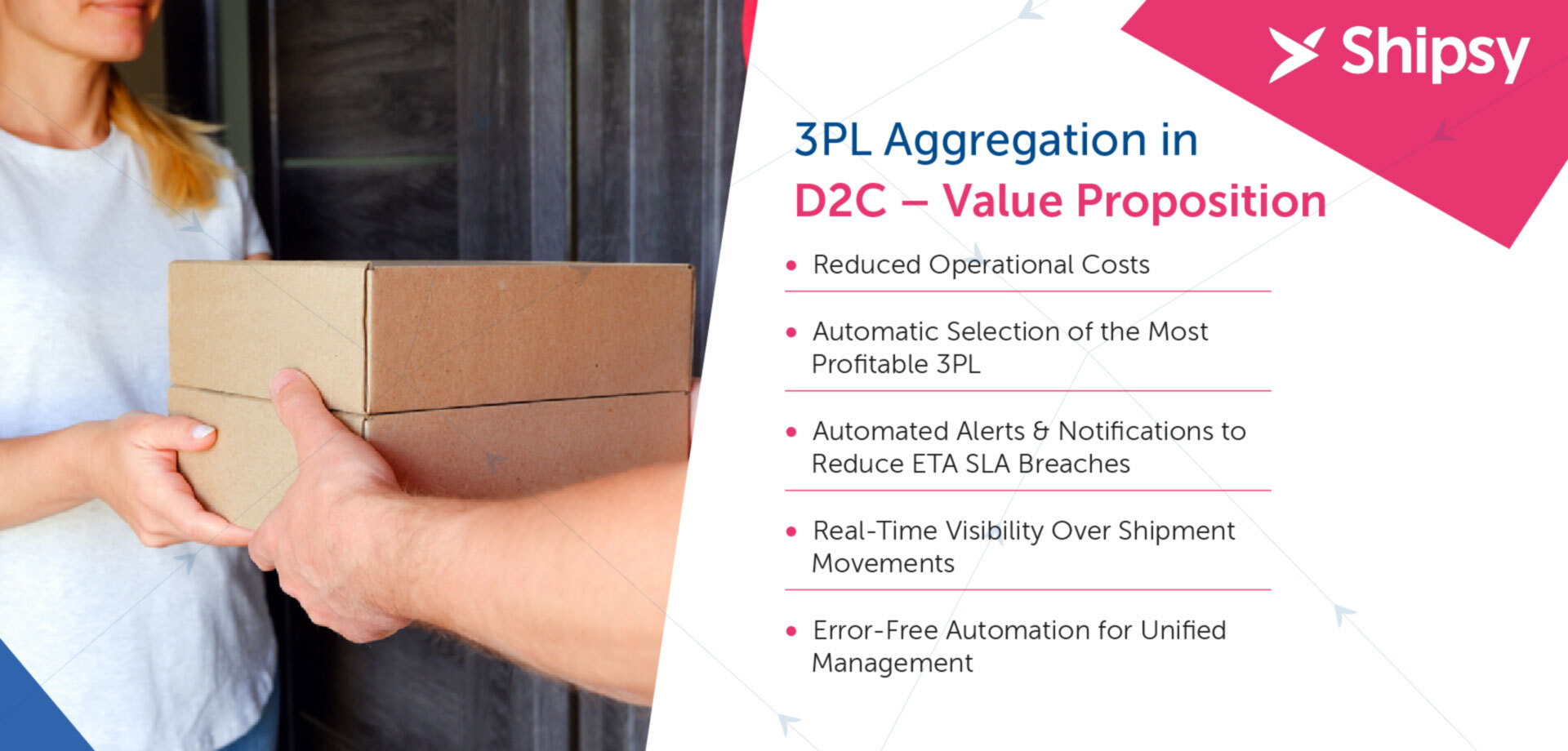
Automatic Selection of the Most Profitable 3PL
A smart 3PL aggregation platform facilitates intelligent carrier allocation. It automatically allocates an order to a 3PL based on the defined rules and 3PL’s performance. While defining rules, businesses can consider attributes such as order type, shipment type, service type, SKU type, weight range, and objectives such as cheapest, fastest, best SLA, best delivery rate, best custom rating, etc.
Automated Alerts & Notifications to Reduce ETA SLA Breaches
Tracking multiple shipments, shipped via one or multiple 3PLs, can be challenging for a D2C brand. A smart 3PL aggregation platform solves this problem by sending real-time alerts on each milestone. Having live status updates and dynamic ETAs minimizes ETA SLA breaches.
Real-Time Visibility Over Shipment Movements
An AI-powered 3PL aggregation platform allows D2C brands to have 360-degree visibility on real-time shipment movements. The platform also standardizes the status and information across the entire supply chain so that D2C brands can also manage and address non-delivery reasons and arrest fake delivery attempts.
Error-Free Automation for Unified Management
With the 3PL aggregation platform, D2C brands can automate different delivery operations, such as scheduling pickup/delivery, carrier allocation, booking, and tracking, and manage them all on a single platform. The platform also provides a means to communicate and collaborate with your internal teams.
A customized 3PL aggregation platform allows D2C businesses to seamlessly manage 3PLs, automate billing and invoicing, and have complete control over shipments. The AI-powered allocation engine chooses the right 3PL for every shipment and reduces shipment returns by 18% and ETA SLA breaches by 37%. This boosts the customer satisfaction by 64% and increases the overall delivery NPS by 26%.
Hence, partnering with multiple 3PLs and leveraging the right automation to manage them smartly is the right way forward for the D2C companies.