

Directly Jump To
- What Is a Hyperlocal Delivery System?
- Hyperlocal Delivery Market – Exploring Its Evolution
- Critical Challenges in Hyperlocal Delivery System
- Hyperlocal Delivery System: Decoding the Puzzle with Smart Automation
- Cost Efficiently Scale Hyperlocal Delivery Operations with Shipsy
Fueled by the pandemic, the hyperlocal delivery system has grabbed the attention of both investors as well as consumers. By the end of 2020, the global hyperlocal service market has seen investments worth $533 million and is estimated to reach $5,188.60 billion by 2030. Due to proximity and increased visibility, brick-and-mortar stores are slowly challenging eCommerce giants with the advent of a hyperlocal delivery model.
However, increased consumer demand coupled with increasing costs begs the question- How to sustain and profit from hyperlocal delivery? Is automation the right answer? What are the potential hurdles?
In this blog, we explore the answers to these questions and many more.
What Is a Hyperlocal Delivery System?
A hyperlocal delivery system refers to the process of delivering products directly from the seller to the consumer within a limited geographical area. Generally, this happens with locations having the same pin codes. The delivery executive picks up the product from a particular seller and delivers the package directly to the customer’s doorstep.
Hyperlocal deliveries belong to the quick-commerce sector because the entire delivery happens within minutes (10 to 45 minutes). However, depending on the location, sometimes it may also take a couple of hours.
The system is also referred to as an “On-demand” business model because the customers themselves initiate the orders.
Hyperlocal Delivery Market – Exploring Its Evolution
What started as an immediate delivery service for food, groceries, and other daily necessities has assumed a mammoth stance over the past two years.
The hyperlocal delivery market currently caters to the delivery of a wide range of goods and services, such as food, drugs, furniture, electronic items, and daily essentials.
Take a look at the following image that shows the numbers from 2020-2024 for a better understanding of the growth of the hyperlocal market.
As market players look to achieve efficient and tighter delivery timelines, they must factor in the increasing operational costs.
This is where automation and process optimization enter the picture. Manual operations are prone to errors and inefficient in carrying out immediate deliveries, especially if the store handles hundreds of orders daily.
After a brief overview, we now explore the notable challenges in executing a hyperlocal delivery system.
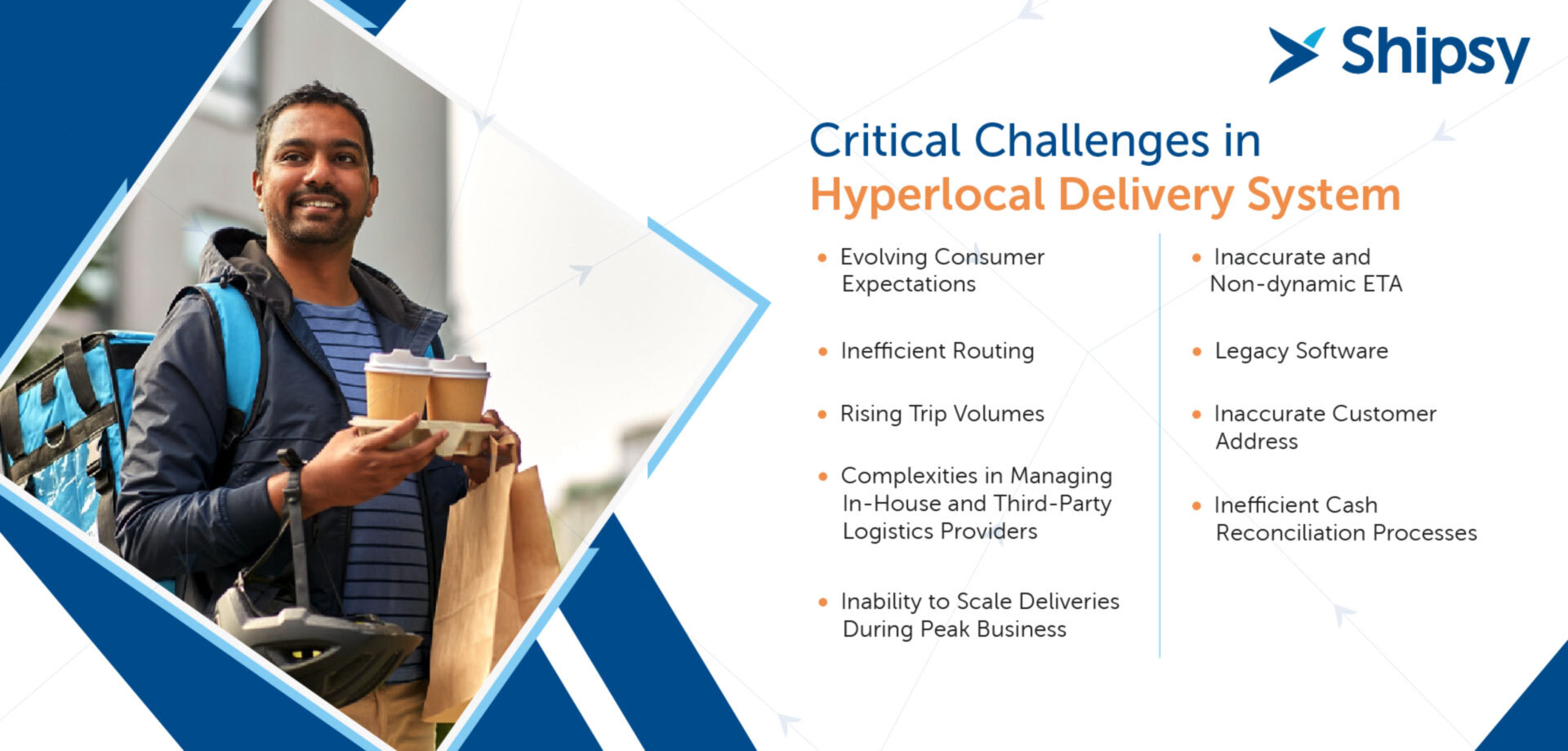
Critical Challenges in Hyperlocal Delivery System****
1. Evolving Consumer Expectations
Customer preferences change over time, and the need for faster deliveries is on the rise. According to the report by McKinsey:
- In the US market, more than 53% are willing to pay a higher fee for faster deliveries. But this drops to 20% if the surcharge is greater than 1 Euro equivalent.
This is generally seen across various consumer groups. The millennials, especially, are willing to pay for quicker delivery. But the willingness decreases as the cost imposed on consumers is increased.
This unwillingness forces the companies to factor in the increasing cost per transaction so as to retain the customers.
2. Inefficient Routing
Routing is one of the major problems in the logistics industry. Few persisting problems, especially in the hyperlocal delivery ecosystem, are:
- A longer route means more time and fuel consumed
- Changes in road conditions like congested routes impact ETAs
- Confusion over delivery location, resulting in increased trip duration
Here, intelligent routing of the driver via optimal routing allows for benefits such as:
- Short and quicker delivery
- Ability to alter route dynamically
- Effective asset utilization through order clubbing
- Access to predictive analysis for data-informed decision making
3. Legacy Software
In a fast-paced world, traditional software severely hampers the operation of your businesses. This can lead to problems such as:
- Improper load allocation, leading to multiple trips
- Inefficient route selection means last-minute route changes
- Absence of real-time tracking
- Out-of-sync delivery notifications, meaning the customer is unaware of updated ETA
A state-of-the-art software platform is necessary to keep up with ever-increasing demands and to attain a real-time view of your end-to-end logistics operations.

4. Rising Trip Volumes
The primary reasons behind rising trip volumes are:
- Lack of proper route planning, leading to frequent changes in routes
- Legacy management software or manual approach creating gaps in operations
- Increase in empty miles
Also, multiple trips made to deliver products in a nearby area lead to the misuse of vital manpower and a waste of fuel.
Intelligent route planning coupled with appropriate road planning allows for maximum utilization of resources, saving money and time.
5. Complexities in Managing In-House and Third-Party Logistics Providers
Onboarding and maintaining a seamless line of communication between the in-house and third-party logistics providers can be a hassle. Some major hurdles while integrating 3PL providers into the system are:
- On-time delivery pickup
- Allocation of delivery product
- Real-time delivery tracking
- Doorstep delivery status
- Failed delivery alert
An intelligent hyperlocal delivery system allows for greater transparency in communication between the in-house and third-party logistics providers. The smart solution also ensures proper load distribution onto the vehicle fleet.
6. Inability to Scale Deliveries During Peak Business
While businesses might receive a somewhat consistent level of orders throughout the year, the holidays or festivals are altogether a different issue. A sudden rise in demand leads to strained logistics resources, resulting in:
- Higher delivery fulfillment time
- Increased chances of missed deliveries
According to McKinsey, 34% of shoppers cite longer delivery times as a reason to shop in stores instead of online.
A hyperlocal delivery solution is adaptable to change. The software accommodates the integration of new delivery agents and ensures proper distribution of deliveries across locations.
7. Inaccurate and Non-dynamic ETA
Consumers are increasingly expecting deliveries within a window of their choosing. But, traditional software does not provide live updates to the ETA status. Moreover, on-road disturbances also add up to a delay in deliveries.
When on-time delivery (OTD) is a necessary feature of your business, smart delivery management is the need of the hour. Hyperlocal delivery systems enable smart route planning, load allocation, vehicle selection, and real-time monitoring for timely and cost-effective deliveries.
8. Inefficient Cash Reconciliation Processes
The Cash-on-Delivery (CoD) feature is one of the biggest drivers of growth in the eCommerce business.
In the absence of a unified reconciliation system, there can be confusion over the status of bills. This increases the scope for errors and leakages. For example, the error may arise due to a miscalculation while accounting for cash payments made on delivery.
Having a smart platform with end-to-end integration allows seamless cash reconciliation by allowing:
- Automated CoD calculations for accurate operations
- Point-of-Delivery mapping with CoD settlements
- Uninterrupted UPI-driven transaction
- Tracking riders post “reached gate” status
9. Inaccurate Customer Address
Delivering to the wrong address severely impacts your business bottom line. Customers’ details are now collected with the automated detail entry feature in hyperlocal delivery management systems to prevent inaccuracies in the information.
It is clear that a robust and reliable automation system is the key to a successful hyperlocal delivery model.
Hyperlocal Delivery System: Decoding the Puzzle with Smart Automation
For a smooth on-demand delivery process, elements such as automation, dynamic routing, intelligent order management, etc., are indispensable. In addition, data analytics and actionable insights are necessary for inventory optimization. This, along with real-time order tracking, ensures excellent customer experience, enhancing transparency and maximizing productivity.
Though automation sounds promising, there is a catch. It is challenging to find a true product fit between client needs and system capabilities. A customized platform would ideally cover the client’s needs by ensuring various service offerings within a single suite.
Read more about the hyperlocal delivery management system: Click Here.
This is where Shipsy enters the fray for building an efficient and scalable hyperlocal delivery system.
Cost Efficiently Scale Hyperlocal Delivery Operations with Shipsy
Shipsy’s AI and automation-powered hyperlocal delivery management system is enabling grocery delivery providers, restaurant chains, and healthcare providers to automate core logistics operations and drastically scale deliveries.
The system automatically plans the most efficient pickup and delivery routes based on multiple external and internal factors like ETAs, customer and store proximity, rider availability, traffic congestions, type of order, and more. It automates order allocation and scheduling to ensure high levels of delivery productivity, reduced manual intervention, lesser operational costs, and more.
Shipsy is enabling hyperlocal delivery providers to:
- Scale on-demand delivery business by 25x in a span of six months
- Increase deliveries per driver by 14%
- Reduce average order allocation time by 45%
- Boost on-time delivery volumes by 24%
- Reduction number of delivery steps by 77%
To know how we can help you achieve these efficiencies and more, sign up for a quick demo here.